
| |

Tips for Healthcare Professionals

COPING WITH STRESS & COMPASSION FATIGUE

As a healthcare professional, you may face stress on the job under usual conditions due to long shifts, competing responsibilities, and witnessing or hearing about difficult patient experiences. As a responder on the front lines of the coronavirus disease 2019 (COVID-19) pandemic, you are likely working longer hours, seeing loved ones less, and working in a more stressful environment. At the same time, you may be coping with the mental health effects that all types of disasters, including public health
emergencies, often have. As such, you may be noticing signs of stress and distress in yourself and your coworkers.

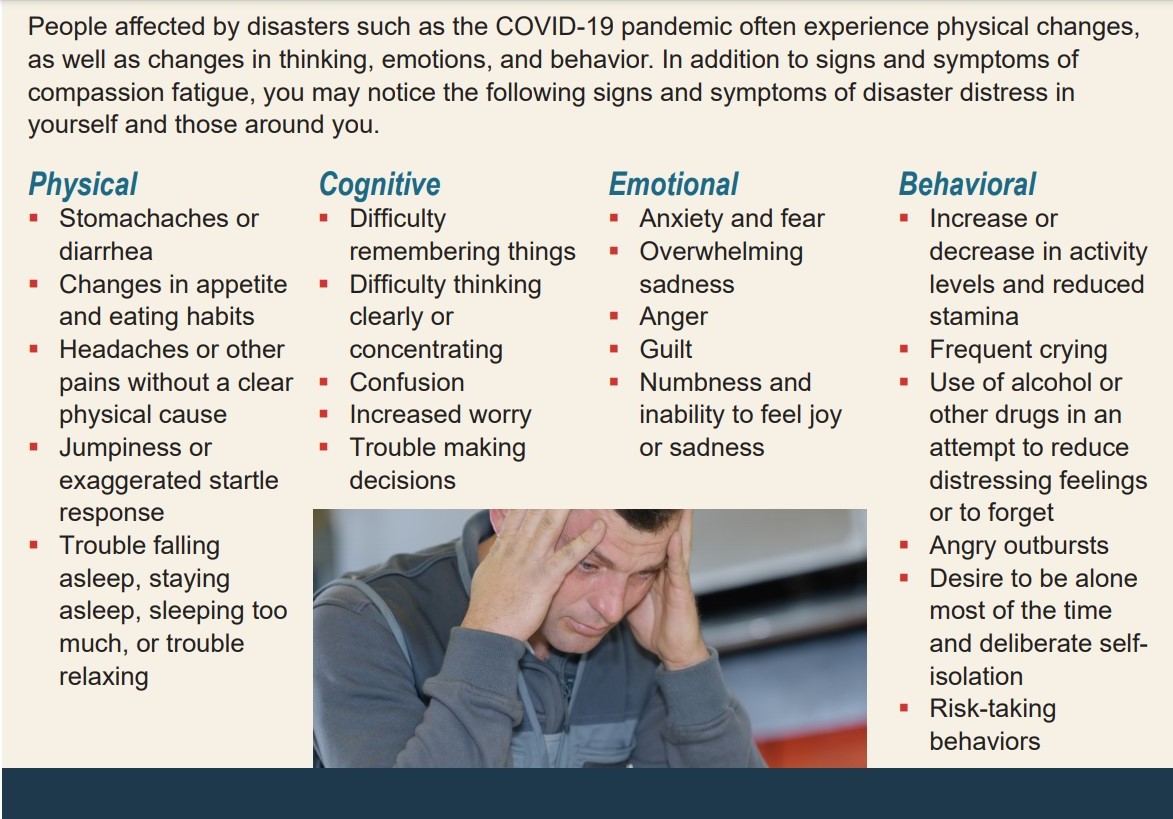
This tip sheet explores stress and compassion fatigue, as well as signs of distress after a disaster. It identifies ways to cope and enhance resilience, along with resources for more information and support.

Similar Posts

  • Autism and Aspergers

    Did you know April is National Autism Awareness Month? Autism is a complex developmental disability that typically appears during the first three years of life and affects a person’s ability to communicate and interact with others. Autism is defined by a certain set of behaviors and is a “spectrum disorder” that affects individuals to varying…

  • Can’t Sleep?

    If you are having trouble sleeping, please join us to hear an important presentation on December 8, Tuesday at noon. Almost everything you’ll ever need to know about sleep -What sleep is -Why sleep matters -How to get a good night sleep Emerson M. Wickwire, PhD, ABPP, CBSM, FAASM who is an Assistant Professor in…

  • May 18 Webinar: Living in Today

    Video Recording A video recording of this webinar is available for you to watch. Living in Today Cherish Yesterday. Dream Tomorrow. Live Today. Join us for a free webinar sponsored by the University of Maryland Department of Psychiatry UMMC EAP Programs. Tuesday, May 18, 2021 at 3:00 pm This webinar will provide tools needed to:…

  • Aging Gracefully

    How to Maintain Brain Health As we age, we need to exercise our brains in various ways to keep them sharp.  Some ways to do that are: Exercise -especially aerobic exercise such as running, walking, playing basketball, dancing, hiking, swimming, and tennis. Eat right-vegetables, fruits, protein and be sure to drink enough water. Stay away…

  • Having Trouble Relaxing?

    This might be the right tool for you! One of our senior counselors, Cheryl Confer, recently attended a workshop on Coherent Breathing. This is a simple breathing practice that is designed to reduce stress and anxiety and create a relaxed state of mind and body.  It is based on a scientific principle of regulating the…